 how-to
How to Avoid Hidden Construction Costs
Table of Contents
- Understand What Hidden Construction Costs Really Are
- Questions to Ask General Contractors Before Hiring
- Review the Contract and Demand Financial Transparency
- Impact of Change Orders on Renovation Budgets
- Calculate Your Construction Contingency Fund
- Monitor Costs in Real Time Throughout the Project
- Protect Yourself with a Clear Scope of Work
- Frequently Asked Questions
Last Updated: September 3, 2026
Understand What Hidden Construction Costs Really Are
Hidden construction costs are expenses that emerge during a project but weren't included in the original estimate or contract. They arise from incomplete scope definition, unforeseen site conditions, or contractor practices that lack transparency.
Common sources include structural surprises, permit delays, material price escalation, and uncontrolled change orders. The difference between a well-managed project and a financial disaster comes down to whether you anticipated these possibilities and built protections into your process.
At King's Choice Solutions, we provide transparent pricing, reliable scheduling, and meticulous craftsmanship. Homeowners who ask the right questions upfront and demand financial transparency avoid the worst surprises. This guide covers the strategies that actually work.
Questions to Ask General Contractors Before Hiring
Before signing, ask questions that reveal how a contractor approaches cost control and communication.
Ask: How do you handle cost overruns? Do you include contingency in your estimate? Request references and ask them whether the final bill matched the initial quote.
Ask whether they use digital tools to track costs and provide weekly budget updates. How do they handle material price fluctuations, lock in prices early or allow adjustments?
Ask about bonding and insurance. Verify liability coverage and surety bonds independently.
Review the Contract and Demand Financial Transparency
Your contract is your only legal protection against hidden construction costs. A detailed contract prevents disputes.
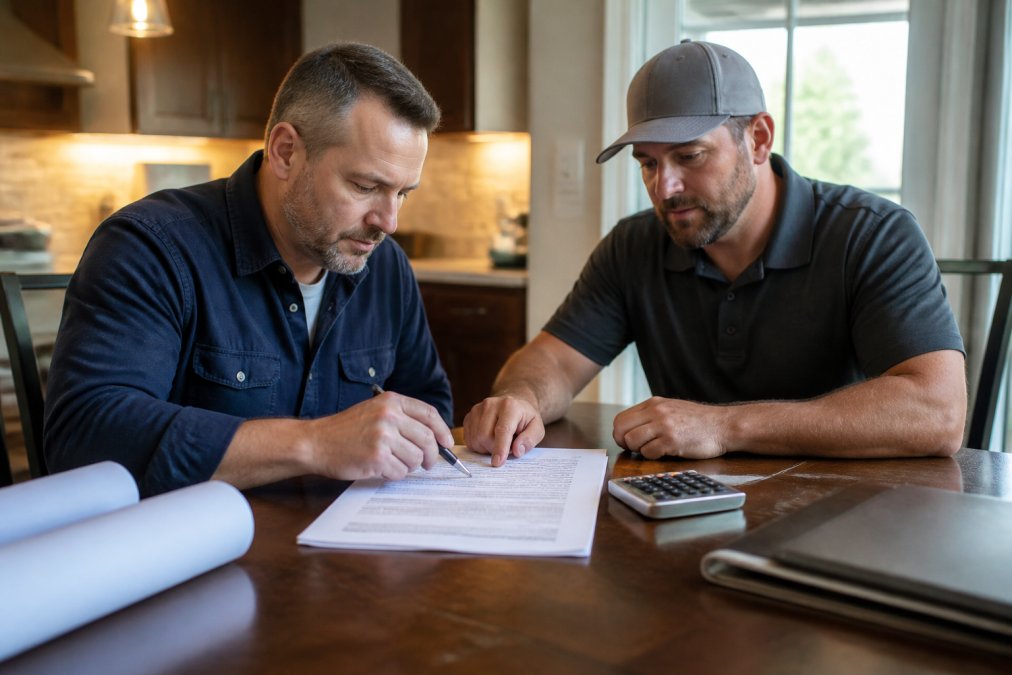
The contract must specify every element with measurable deliverables. Instead of "paint interior," specify "interior paint, two coats, Benjamin Moore Aura finish, all rooms listed on attached floor plan." Vague language creates cost disputes.
Demand an itemized cost breakdown showing labor, materials, and overhead separately for each phase. A contractor who refuses is hiding something.
Fixed-Price vs. Time and Materials Agreements
Fixed-price contracts lock total cost upfront and protect you, but often come with higher initial bids because contractors build in risk premiums.
Time and materials contracts charge hourly labor plus materials plus markup. They're flexible but expose you to unlimited expenses. Insist on a guaranteed maximum price (GMP) clause that caps total costs.
For renovation work, use fixed-price for predictable elements and time and materials with a GMP for discovery-dependent work. This balances cost certainty with flexibility.
Impact of Change Orders on Renovation Budgets
Change orders are how scope expands and costs grow. The problem is uncontrolled change orders that accumulate without approval or tracking.
A single change order might seem minor, but three or four easily push budgets 15-20% over initial estimates (peer-reviewed research).
Establish a change order protocol before work begins. Require written approval for any work outside original scope. Set a threshold, any change over $500 requires your sign-off.
Track every change order in a running log. Note the date, description, cost, and who approved it. This creates accountability and prevents disputes about what was agreed to. Digital project management tools make this automatic.
Calculate Your Construction Contingency Fund
A contingency fund is money set aside for genuine unknowns, not mismanagement or scope creep. How you structure and protect this reserve determines whether it saves you or becomes a source of conflict.
Sizing Contingency by Project Type and Risk
Most renovation projects benefit from a 10-15% contingency reserve (aia.org). For older structures or deep renovation, lean toward 15-20%. For straightforward work, 10% often suffices. Projects involving foundation work, asbestos, or historic preservation should budget 20-25%.
Calculate this on the total project cost, not just labor. If your renovation budget is $50,000, set aside $5,000-$7,500 as contingency. If you're doing a full kitchen remodel in a 1970s home, $50,000 base might justify $10,000 contingency (20%) because hidden plumbing, electrical, or structural issues are nearly certain.
Protecting Contingency from Scope Creep
The biggest threat to contingency reserves is treating them as a slush fund for owner-requested changes. Upgrading appliances or changing finishes mid-project is scope expansion, not a hidden cost. These should come from your personal budget.
Establish a written contingency protocol before work begins. Define legitimate contingency draws: structural discoveries, site conditions, code compliance issues, or material defects. Everything else is a change order.
Require the contractor to document any contingency request in writing with photos, explanation of why it's necessary, and cost estimate. You review and approve before work proceeds. This prevents the contractor from quietly spending contingency and presenting you with a bill at the end.
What Happens When Contingency Is Exhausted
If legitimate discoveries exceed contingency, the contractor cannot force you to pay beyond the agreed contract price unless you approve a change order. However, refusing to fund necessary repairs can halt the project.
This is where a guaranteed maximum price (GMP) clause in your contract becomes critical. A GMP states that the contractor absorbs costs beyond the agreed total, up to the GMP limit. Without it, you're liable for every discovery. With it, the contractor has incentive to manage costs carefully and absorb minor overruns rather than constantly requesting change orders.
If you exhaust contingency and face a legitimate cost overrun, negotiate with the contractor. Ask whether they can absorb part of the cost, whether the work can be phased (complete critical items now, defer cosmetic work), or whether you can reduce scope elsewhere to stay on budget.
Contingency as a Shared Protection
The contingency protects both you and the contractor. It gives you cushion for real discoveries without creating disputes. It gives the contractor confidence that legitimate cost increases won't become arguments or payment disputes. A project with no contingency is a project waiting for conflict.
Monitor Costs in Real Time Throughout the Project
Real-time monitoring prevents surprise bills at the end. Weekly cost tracking reveals trends early, when you can still adjust.
Weekly Cost Reporting and Budget Variance Tracking
Request weekly cost reports showing work completed, labor hours, materials purchased, and remaining budget. Compare to the original estimate. If you're 30% through the project but 40% through the budget, address it immediately.
Use project management software to centralize cost data. Meet regularly, at minimum monthly, weekly for larger projects. Walk the site together and discuss what's been completed, what's next, and emerging issues.
Hidden Supply Chain and Logistics Costs
Supply chain disruptions have created hidden costs rarely in initial estimates: expedited shipping, storage fees, labor delays, and price volatility between bid and purchase.
If delivery is delayed 4-6 weeks, material prices may rise 5-15% by purchase time (bls.gov). Ask your contractor: How do you handle material price increases? Do you lock in prices early? Do you allow price adjustment clauses, and what's the threshold?
Shipping and logistics costs are often buried in material line items. For large projects, request a breakdown showing material, shipping, and storage costs separately. Storage fees accumulate quickly if materials arrive weeks before installation.
Labor delays from supply shortages cascade: if framing materials are delayed two weeks, your project stretches from 8 weeks to 12 weeks, extending overhead and labor costs. Ask the contractor: What's your contingency plan if a critical material is delayed? Will you absorb idle labor costs?
Insurance and Liability Coverage Gaps
Before work begins, verify that your contractor carries adequate liability insurance and that you're named as an additional insured on their policy.
General liability insurance typically covers bodily injury and property damage. Standard coverage is $1 million per occurrence. Verify policy limits and ensure coverage is sufficient.
Workers' compensation insurance is mandatory in most states. Verify the contractor carries this before work begins.
Ask the contractor whether their insurance covers accidental damage to existing structures and what the exclusions are.
Ask your insurance agent whether your policy covers work in progress and whether you need a builders risk policy. Builders risk policies typically cost 0.5-1% of project value and protect against theft, weather damage, and vandalism.
Tracking Contingency Drawdowns and Change Orders
Track every contingency drawdown and change order separately from the base budget. If you're halfway through the project and have drawn 80% of contingency, you're at risk and can make adjustments.
Protect Yourself with a Clear Scope of Work
Your scope of work defines what the contractor will and won't do. Everything not explicitly included is out of scope. This is your primary defense against hidden costs.
A strong scope includes specific materials and finishes, dimensions and quantities, site conditions assumed, work excluded, timeline, warranty terms, and payment schedule.
Attach drawings, photos, and specifications. The more specific you are, the fewer surprises emerge.
Have the contractor sign off on the scope before work begins. This creates a mutual understanding. If they later claim work was outside scope, you have documentation. If you request changes, they're documented as change orders with associated costs.
Hidden construction costs don't have to derail your project. They're manageable when you start with clear communication, detailed contracts, and ongoing transparency. Ask tough questions before hiring. Demand itemized breakdowns and fixed-price agreements where possible. Track spending weekly. Protect yourself with a detailed scope of work and a contingency fund.
King's Choice Solutions brings this level of precision to every project. We provide transparent pricing, detailed cost tracking, and direct communication with the owner throughout the renovation. Our commitment to finishing every job started means you get reliable project management from permits to final walkthrough, no surprises, no abandoned projects. Call for a free estimate and see how professional cost management protects your investment.
Frequently Asked Questions
What are the most common hidden costs in home renovation projects?
The most common hidden construction costs include permit and inspection fees, structural issues discovered during work, material price escalations, site condition surprises (asbestos, mold, foundation problems), subcontractor markups, and labor rate changes. Permitting and regulatory fees are often overlooked because they're handled separately from the contractor's quote. Site surveys and architectural revisions discovered mid-project can also add significant expense. Always ask contractors to itemize these separately.
How much of a contingency fund should I set aside for construction?
Most construction professionals recommend setting aside 10-20% of your total project budget as a contingency fund, though complex renovations or projects involving older homes may warrant 20-25%. A construction contingency fund calculation should account for your project's complexity: simpler projects like painting or deck work may need only 10%, while structural renovations or custom work should lean toward 15-20%. This fund covers unforeseen site conditions, material price fluctuations, and scope changes without derailing your finances.
How do change orders impact the final cost of a construction project?
Change orders are one of the biggest drivers of budget overruns. Each change order typically adds 5-15% to labor costs due to scheduling delays, material procurement, and subcontractor coordination. The impact of change orders on renovation budgets compounds when multiple changes occur: one change may delay material delivery, which delays labor, which creates cascading costs. Establish a written change order process with your contractor upfront that requires your approval and a price estimate before any work scope changes.
What questions should I ask a contractor to avoid surprise fees?
Ask contractors to clarify what's included in their quote: permits, inspections, disposal, site cleanup, and contingency labor. Request itemized estimates broken down by material, labor, and overhead. Ask about their payment schedule and whether final payment is due only after you're satisfied with the work. Inquire about their experience with your specific project type and whether they've encountered similar site conditions. Ask for references from recent projects of similar scope and budget. Finally, confirm whether they carry liability insurance and are properly licensed.
This article was written using GrandRanker
Frequently Asked Questions
Q: What are the most common hidden costs in home renovation projects?
A: The most common hidden construction costs include permit and inspection fees, structural issues discovered during work, material price escalations, site condition surprises (asbestos, mold, foundation problems), subcontractor markups, and labor rate changes. Permitting and regulatory fees are often overlooked because they're handled separately from the contractor's quote. Site surveys and architectural revisions discovered mid-project can also add significant expense. Always ask contractors to itemize these separately.
Q: How much of a contingency fund should I set aside for construction?
A: Most construction professionals recommend setting aside 10-20% of your total project budget as a contingency fund, though complex renovations or projects involving older homes may warrant 20-25%. A construction contingency fund calculation should account for your project's complexity: simpler projects like painting or deck work may need only 10%, while structural renovations or custom work should lean toward 15-20%. This fund covers unforeseen site conditions, material price fluctuations, and scope changes without derailing your finances.
Q: How do change orders impact the final cost of a construction project?
A: Change orders are one of the biggest drivers of budget overruns. Each change order typically adds 5-15% to labor costs due to scheduling delays, material procurement, and subcontractor coordination. The impact of change orders on renovation budgets compounds when multiple changes occur: one change may delay material delivery, which delays labor, which creates cascading costs. Establish a written change order process with your contractor upfront that requires your approval and a price estimate before any work scope changes.
Q: What questions should I ask a contractor to avoid surprise fees?
A: Ask contractors to clarify what's included in their quote: permits, inspections, disposal, site cleanup, and contingency labor. Request itemized estimates broken down by material, labor, and overhead. Ask about their payment schedule and whether final payment is due only after you're satisfied with the work. Inquire about their experience with your specific project type and whether they've encountered similar site conditions. Ask for references from recent projects of similar scope and budget. Finally, confirm whether they carry liability insurance and are properly licensed.